Reverse Shoulder Replacement
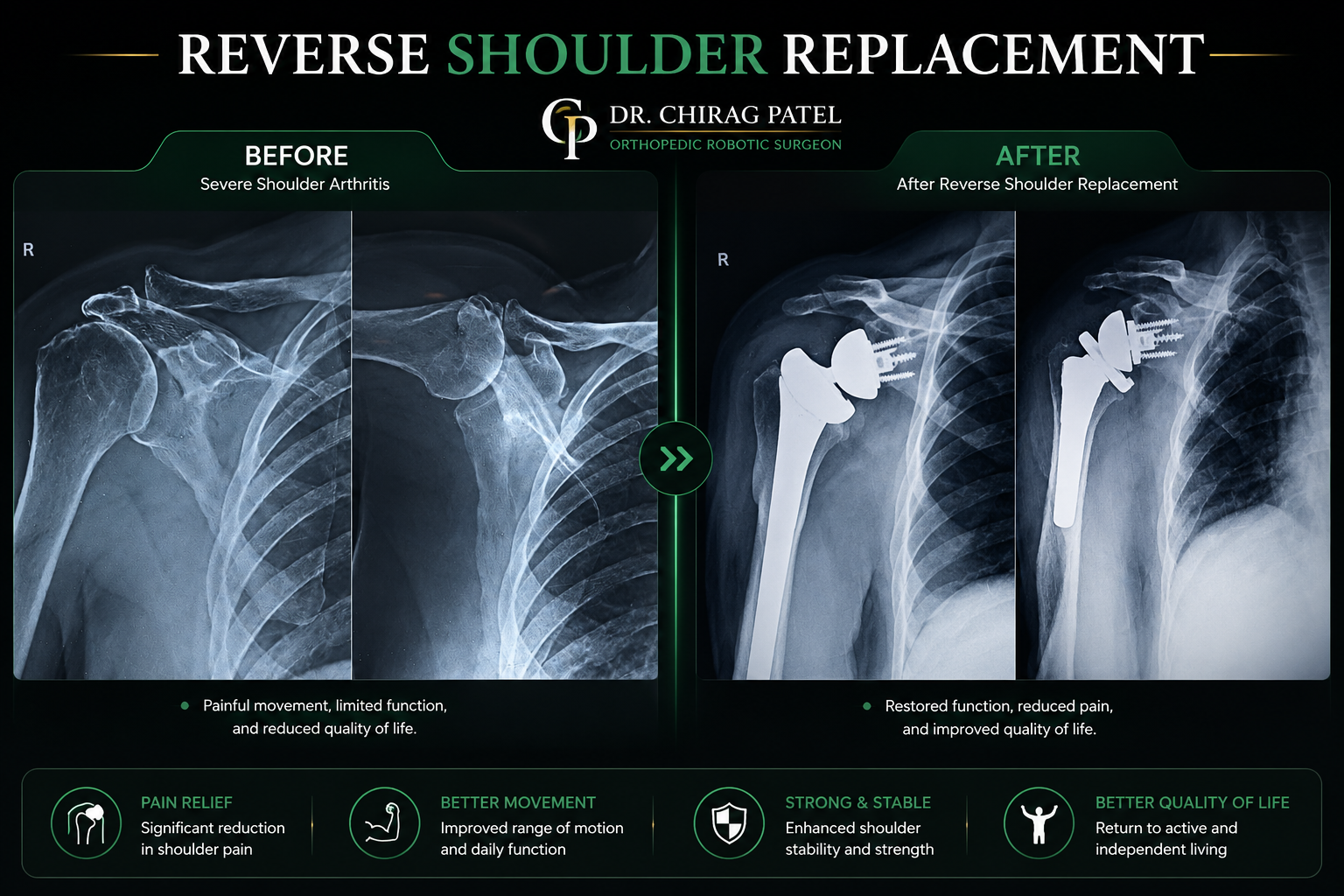
Reverse Total Shoulder Arthroplasty (rTSA)
When rotator cuff arthropathy, severe shoulder arthritis, or irreparable cuff tears limit your life, Reverse Total Shoulder Arthroplasty restores overhead function with prosthetics engineered to last 15+ years.
How We Treat This
Total (Anatomic) Shoulder Arthroplasty
The gold standard for glenohumeral osteoarthritis with an intact rotator cuff. The damaged humeral head and glenoid socket are replaced with a metal ball and polyethylene cup — restoring natural shoulder mechanics.
- ✓ Replaces both ball (humerus) and socket (glenoid)
- ✓ Ideal for osteoarthritis with intact rotator cuff
- ✓ Natural shoulder biomechanics restored
- ✓ Prosthetics lasting 15–20+ years
Reverse Total Shoulder Arthroplasty
Designed for rotator cuff tear arthropathy and irreparable rotator cuff tears. The ball-and-socket positions are reversed — allowing the deltoid muscle to power arm elevation independently of the damaged cuff.
- ✓ Ball fixed to scapula, socket to humerus
- ✓ Deltoid compensates for absent rotator cuff
- ✓ Effective for cuff tear arthropathy & revision cases
- ✓ Restores overhead lifting ability
Partial Shoulder Replacement (Hemiarthroplasty)
When only the humeral head is damaged and the glenoid socket remains healthy, partial replacement resurfacing the ball alone is the bone-conserving choice.
- ✓ Replaces humeral head only
- ✓ Preserves intact native glenoid socket
- ✓ Bone-conserving — future revision options retained
- ✓ For AVN, selected fractures & isolated humeral damage
Why Choose This Approach
Significant Pain Relief
Shoulder replacement consistently eliminates or dramatically reduces chronic joint pain — often within the first weeks of recovery.
Restored Overhead Mobility
Most patients regain the ability to reach overhead and perform daily activities comfortably.
15+ Year Durability
Modern prosthetic designs last 15–20+ years. Many patients retain their implant for life.
Outpatient Option
Selected cases are performed as same-day or next-day discharge procedures with early physiotherapy mobilisation.
Frequently Asked
What conditions require shoulder replacement?+
The most common indications are severe glenohumeral osteoarthritis, rotator cuff tear arthropathy, rheumatoid arthritis, and avascular necrosis (AVN) — when non-surgical treatments have failed to control symptoms.
What is the difference between total and reverse shoulder replacement?+
Total (anatomic) replacement preserves natural mechanics and is best when the rotator cuff is intact. Reverse arthroplasty flips the ball-and-socket design, allowing the deltoid to power arm movement when the rotator cuff is torn or irreparable.
How long is recovery after shoulder replacement?+
You will wear a sling for 4–6 weeks. Light daily activities resume at 2–3 weeks. Formal physiotherapy begins soon after surgery, with full recovery typically reached at 3–6 months.
How long does a shoulder implant last?+
Modern shoulder implants last 15–20+ years in most patients. Precise surgical technique and adherence to post-operative rehabilitation protocols maximise longevity.